
Ketamine for Depression: A Breakthrough in Rapid Relief
How Ketamine Works
Traditional antidepressants target neurotransmitters like serotonin, dopamine, and norepinephrine (aka monoamines). Ketamine works differently, acting on glutamate, the brain’s most abundant neurotransmitter and a key driver of learning, memory, and neuroplasticity.
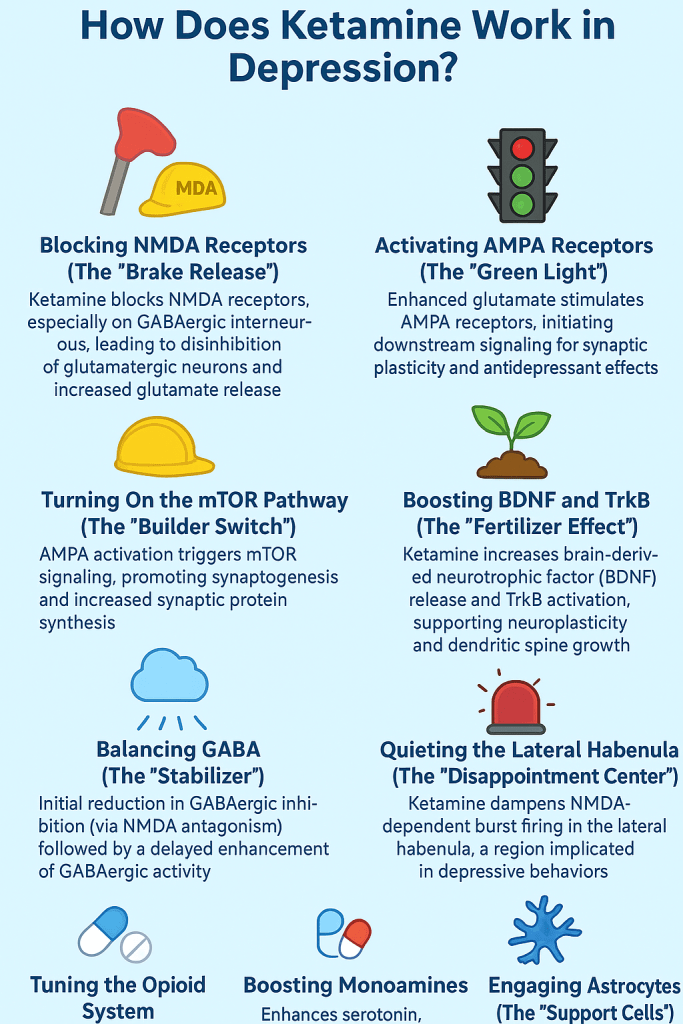
Ketamine has so many mechanisms of action that I had to make an infographic or you would get bored reading about them all. The actions of ketamine can be likened to a symphony—these different pathways work in concert to achieve a synergistic effect more powerful than the single pathways on their own.
1. Blocking the Brake
Ketamine blocks a receptor called NMDA (N-methyl-D-aspartate). You can think of NMDA receptors as “brakes” on the glutamate system. By blocking them, ketamine briefly lifts the brake, allowing a surge of glutamate activity.
2. Rebuilding Connections (Synaptogenesis)
That surge sparks a cascade of brain activity, activating AMPA receptors and triggering the release of Brain-Derived Neurotrophic Factor (BDNF). BDNF is often called “fertilizer for the brain.” It helps neurons form new connections, repair damaged ones, and grow stronger networks.
In depression, chronic stress causes brain cells to lose connections—a process called dendritic atrophy. IV ketamine appears to reverse this damage, leading to rapid rewiring of brain circuits.
3. Resetting Brain Networks
Beyond rewiring, ketamine also seems to calm an overactive Default Mode Network (DMN)—the brain’s “autopilot” linked to repetitive, self-critical rumination. Patients often describe this effect as a welcome “quieting” of negative thoughts, allowing space for new perspectives and healing.
Who should seek treatment with ketamine?
Treatment-resistant depression
For decades, treatment for depression has relied mostly on medications that adjust levels of serotonin and related neurotransmitters (such as Prozac, Zoloft, Lexapro, Wellbutrin, Remeron, etc). These medicines help many people, but for at least one-third of patients, these drugs never work. After multiple failed trials, the burden of side effects often outweighs the chance of success. This is what we call treatment-resistant depression (TRD).
Ketamine is very effective for people who have not has success with multiple previous antidepressants, and it is very effective for people who are depressed and suicidal.

Is treatment-resistance common? The STAR*D trial was a huge study of real-world antidepressant treatment funded by the NIH in the early 2000s. It found that about a third of people respond to their first antidepressant, and we get diminishing returns with subsequent medication trials. For some people these drugs will never lead to remission. A recent analysis of the STAR*D data found that only 35% of patients are in remission after 4 drug trials.
Treatment-resistant depression is defined as depression that has not responded to two courses of treatment with conventional antidepressants (at an adequate dose, for an adequate duration of time). If you could not tolerate the side effects of antidepressants, that is also considered a failed treatment. If conventional antidepressants have not worked for you, then advanced therapies like ketamine, transcranial magnetic stimulation, vagus nerve stimulation, and electroconvulsive therapy may offer hope for recovery.
Why use intravenous ketamine?
The Benefits of the Infusion Route
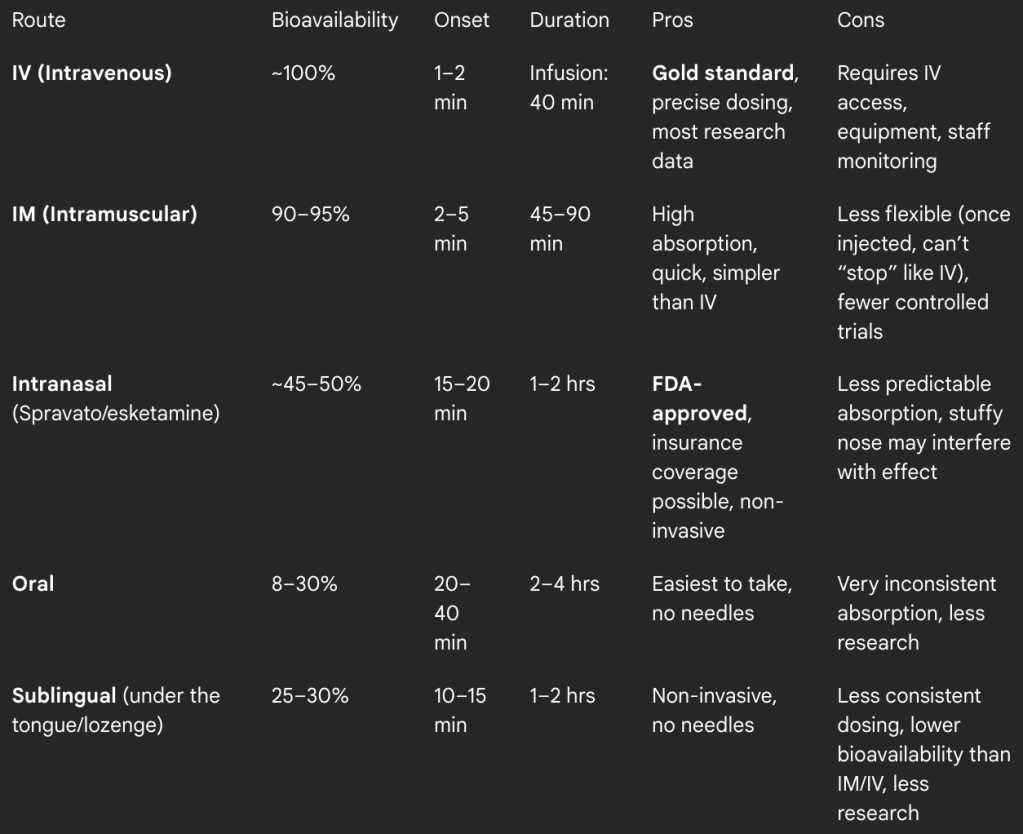
Ketamine can be given orally, intranasally, or intramuscularly, intravenously. But the IV route is most effective:
- Precise Dosing: IV infusions deliver 100% of the dose directly into the bloodstream. Oral dosing is unpredictable, with only 8–30% reaching the brain.
- Personalization: Evidence suggests ketamine follows an “inverted U-shaped” dose-response curve—too little doesn’t help, too much reduces benefit. IV allows careful, individualized adjustment to find each patient’s optimal dose. We will track your progress and adjust the dose according to your response.
- Safety and comfort: Patients are continuously monitored. If discomfort or side effects occur, the infusion can be paused or stopped immediately. This cannot be guaranteed with at-home dosing.
What Patients Can Expect
Rapid Relief
Unlike traditional antidepressants that may take weeks, ketamine often works within hours to days. This is especially important for patients in severe distress or with suicidal thoughts.
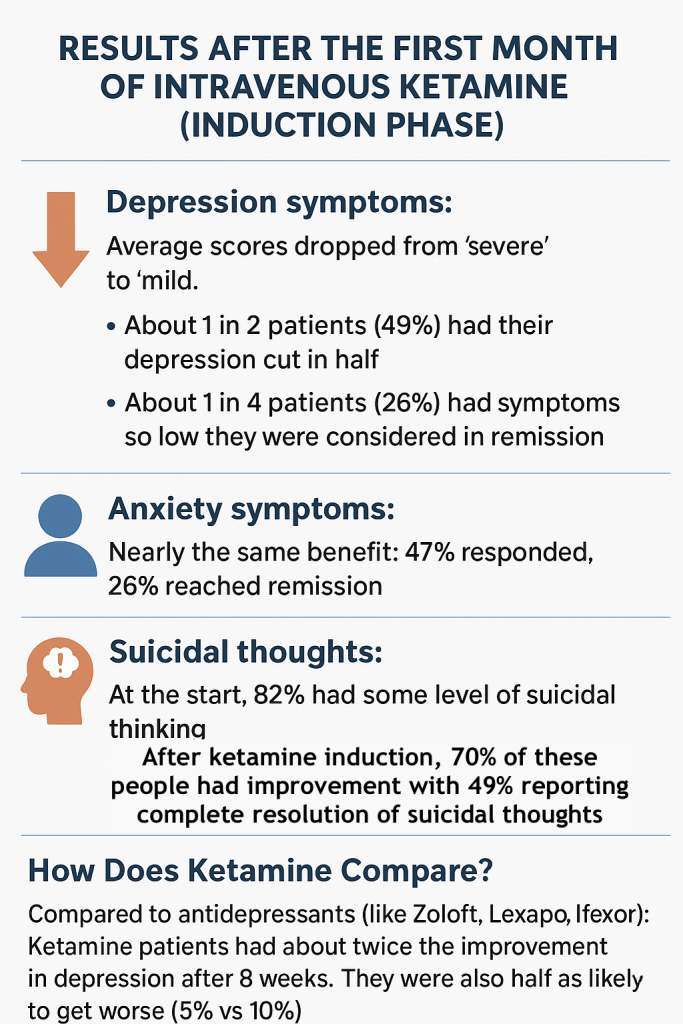
A study that looked at real-world intravenous ketamine treatment shows dramatic reductions in depression and anxiety. Most people who are suicidal feel much better, quickly, with half experiencing a complete resolution of their suicidal ideation.
Response Rates
- Real-world studies show about 50% of patients respond (symptoms cut in half).
- About 30% achieve remission (symptoms essentially gone).
- Even more encouraging: 80% of responders maintain benefits for at least a month, and 60% for two months, sometimes without maintenance treatments.
- This means that the most likely outcome of your ketamine treatment is drastic improvement or complete remission of depression.
Side Effects
Side effects are typically mild and temporary, including:
- Nausea
- Drowsiness
- Headache
- Short-term increases in blood pressure or heart rate
Importantly, bladder issues seen in recreational misuse have not been reported with the low, carefully monitored doses used in IV therapy.
The Future: Toward Personalized Protocols
Most ketamine clinics use a fixed-dose schedule (e.g., 2–3 infusions per week for 2–3 weeks). But emerging research suggests that personalized, flexible dosing may improve remission rates. By adjusting doses based on patient response—using weekly mood assessments—we may get even better outcomes.
Think of it like watering a plant: too little water and it withers, too much and the roots rot, but the right amount allows it to thrive. Ketamine seems to follow the same principle.
Key Takeaways
- IV ketamine is a major breakthrough for patients with treatment-resistant depression, offering rapid relief when other options have failed.
- It works differently from traditional antidepressants, not just changing brain chemistry but actively rebuilding brain connections.
- Personalized dosing and supervised care are essential for both safety and best outcomes.
- While not a cure-all, ketamine offers hope for many who have been living without it.
If you or someone you love is struggling with depression that hasn’t responded to standard treatment, IV ketamine may represent a new chance at healing.
What’s Spravato®?
- Ketamine is a mixture of two mirror-image molecules (R- and S-ketamine), and both molecules together are called racemic ketamine. Ketamine was discovered in 1962 and initially used as an anesthetic/sedative. When I worked in the ICU, it was my first-choice to use for sedation because of its excellent safety profile. Over the years it emerged that there was more to ketamine than just its sedative properties, researchers tested ketamine for treating depression and found it could help people who hadn’t improved with standard antidepressants — often working within hours instead of weeks—truly a miracle drug.
- Because ketamine is a very old drug, it’s generic and it can’t be patented anymore. That means drug companies can’t make large profits from selling ketamine for depression, even though it may work very well. No big profits => no clinical trials => no FDA approval => no insurance coverage. But if the formulation was changed, it could be patented and the gravy train could roll.
- Spravato® (esketamine) nasal spray is the S-enantiomer (one half) of racemic ketamine. Just like racemic ketamine, it produces a short-term block of NMDA receptors and downstream increases in glutamate/AMPA signaling that are thought to drive rapid synaptogenesis/neuroplasticity and rapid improvement of depression.
- Jansen patented esketamine, and in 2019 they earned FDA approval for (1) treatment-resistant depression (TRD) and (2) major depressive disorder with acute suicidal ideation or behavior.
- If you have treatment-resistant depression meet the criteria for those diagnoses, Spravato® (esketamine) is likely to be covered by your insurance
- Intravenous racemic ketamine is cash-pay and not covered by any insurers.
What’s the difference between Spravato® and ketamine?
Route, dosing, and practical administration
- Both are administered in-office under medical observation. You cannot drive for the entire day after ketamine/esketamine, and you must remain in clinic for a time afterwards for observation. Observation time is very relaxing, and HHNY is a vibey clinic.
- IV racemic ketamine
- Typical dose: 0.5 mg/kg intravenous infusion over ~40 minutes at most ketamine clinics, though the HHNY protocol differs from what is typically done because we will titrate your dose to effect based on depression rating scales. It’s given in a monitored clinic/infusion setting, and patients will remain in the clinic afterwards to relax and continue observation. Most clinics use a twice weekly x4 weeks induction. HHNY recommends once weekly infusions for 6 weeks for IV ketamine induction.
- Typical dose: 0.5 mg/kg intravenous infusion over ~40 minutes at most ketamine clinics, though the HHNY protocol differs from what is typically done because we will titrate your dose to effect based on depression rating scales. It’s given in a monitored clinic/infusion setting, and patients will remain in the clinic afterwards to relax and continue observation. Most clinics use a twice weekly x4 weeks induction. HHNY recommends once weekly infusions for 6 weeks for IV ketamine induction.
- Spravato (esketamine nasal spray)
- Supplied as measured nasal devices (28 mg per device). Typical dosing options include 56 mg or 84 mg per session, given in clinic under supervision; initial schedules often involve twice-weekly dosing for the first month then spacing out. Spravato must be dispensed/used within the FDA REMS program and patients are required to relax in the clinic for observation at least 2 hours after dosing.
- Supplied as measured nasal devices (28 mg per device). Typical dosing options include 56 mg or 84 mg per session, given in clinic under supervision; initial schedules often involve twice-weekly dosing for the first month then spacing out. Spravato must be dispensed/used within the FDA REMS program and patients are required to relax in the clinic for observation at least 2 hours after dosing.
Efficacy — what the evidence says
- A meta-analysis that pooled results of randomized trials concluded that intravenous racemic ketamine produced larger response and remission rates than intranasal esketamine in the aggregated literature available at the time. In plain terms: racemic IV ketamine tended to help a larger proportion of people, and to do so more strongly, in those trials. Other systematic review have come to the same conclusion—Spravato® (esketamine) is very effective for depression; however, intravenous ketamine is more effective.
- Direct comparisons: There are relatively few head-to-head randomized trials comparing IV racemic ketamine and intranasal esketamine; most evidence comes from separate trials and meta-analytic comparisons. That means apparent differences could reflect differences in study design, patient selection, or dosing rather than a pure drug effect
- Clinical magnitude: Typical real-world / trial figures you’ll see:
- IV racemic ketamine: The largest real-world data set shows 50% response (50% reduction in symptoms) and 30% of people have complete remission of depression.
- Esketamine (Spravato): Roughly half to 60% of patients taking Spravato alongside an oral antidepressant show a major improvement (“response”) by Day 28.
- About 1 in 5 (≈ 20–25%) of those patients reach remission (symptoms so low they’re considered close to asymptomatic) by 28 days.
Speed and durability of effect
- Speed: Both ketamine formulations can act within hours to days; IV ketamine and Spravato commonly yield rapid improvements often seen within 24–72 hours.
- Durability:
- IV racemic ketamine often needs repeated/maintenance infusions because effects after a short induction can wane; however, real-world maintenance data suggest many patients maintain gains for weeks to months when given ongoing maintenance schedules.
- Esketamine has randomized trial data and longer-term follow-up showing benefit when used per labeled maintenance schedules; it also has data showing relapse reduction in those who remain on maintenance, and relapse seems preventable with occasional maintenance treatments.
What are the other administration routes for ketamine?
Yes, but we don’t ususally incorporate all of them at Happy Healthy New York. If you’re interested in intramuscular, oral, or sublingual ketamine, it’s something we can discuss. Presently, we require all ketamine therapy to be done in-clinic. There may come a time in the future where oral/sublingual dosing can be done at home over telehealth monitoring with a nurse from HHNY.
Important notes on ketamine and Spravato®
Depression can feel overwhelming, especially when standard treatments haven’t worked. Ketamine therapy—whether intravenous racemic ketamine or Spravato® (esketamine)—offers hope for many people living with treatment-resistant depression. The science is evolving rapidly, and with careful monitoring, individualized dosing, and compassionate care, patients can experience relief that once seemed impossible.
At Happy Healthy New York, our team combines the best of evidence-based medicine with a patient-centered approach. Every treatment plan is tailored, every session is monitored, and every patient is supported along the way.
If you live in NYC, and you’re curious about whether ketamine treatment is right for you, we’d love to talk. If you are curious about whether or not your insurance will cover Spravato, get in touch with us.
📞 Text: 833-HAPPYNY (833-427-7969)
📧 Email: info@happyhealthyny.com
Important Notes
- Ketamine and Spravato are not first-line treatments for depression. They are used when other antidepressants have not worked or have caused intolerable side effects.
- Treatment must be done in a certified medical setting with monitoring. You will be required to stay for a time after your ketamine session. You will not be able to drive the day of your session.
- Results vary. Some patients may not respond, while others may see lasting improvement.
Ketamine FAQ
How many ketamine treatments will I need?
Most people begin with an induction phase: several IV ketamine infusions or Spravato® sessions over 4–6 weeks. After that, maintenance sessions may be scheduled every few weeks or months. At Happy Healthy New York, we personalize your plan so you get the right number of treatments for lasting results.
Is ketamine safe?
Yes—intravenous and intranasal ketamine is very safe when administered in a professional setting. I have years of experience using ketamine at all dose levels—from general anesthesia in ventilated patients to other patients who are in acute psychiatric crises and need ketamine administered emergently. At HHNY, you’ll be in a relaxing setting where we will monitor your blood pressure, heart rate, and comfort throughout your session. Side effects such as mild nausea, dizziness, or fatigue usually resolve the same day.
What’s the difference between IV ketamine and Spravato® (esketamine nasal spray)?
- IV ketamine: Uses the original racemic ketamine (R- and S-ketamine), delivered directly into the bloodstream. It’s highly effective but currently cash-pay only. Infusions are performed in our clinic in Ridgewood, Queens (New York City).
- Spravato®: The FDA-approved nasal spray form of esketamine. It’s usually covered by insurance for patients with treatment-resistant depression or suicidal thoughts, and is given under supervision in our clinic in Ridgewood, Queens.
Does insurance cover ketamine therapy?
IV ketamine infusions are not covered by insurance. Spravato® is often covered by major insurers in New York City if you meet criteria for treatment-resistant depression. We help patients check benefits and handle the prior authorization process so you know what to expect financially.
How quickly will ketamine help my depression?
Unlike standard antidepressants, which may take 6–8 weeks, ketamine and Spravato® can reduce symptoms within hours to days. Many patients in our NYC clinic report a noticeable lift in mood after their first few sessions.
Can I keep taking my antidepressants while on ketamine?
Yes. Most patients continue their regular medications. We’ll review your prescriptions carefully and design a safe treatment plan that fits with your current regimen.
Will ketamine cure my depression?
Ketamine and Spravato® are not cures, but they can provide powerful relief and open the door to long-term recovery. Some people need occasional “booster” sessions, while others stay well for months without further treatment.
| Ketamine can decrease depressive symptoms within hours of administration, but a single infusion may only yield a few days of response. |
Do I need someone to drive me home after treatment?
Yes. Whether you receive IV ketamine or Spravato®, you cannot drive until the next day. Please arrange for a ride home from our clinic after your appointment.
How do I get started?
Send an email to info@happyhealthyny.com or a text message to 833happyNY. We will set aside an hour to talk in a semi-structured telehealth interview and figure out what treatment is right for you.
What do I need to bring to my session?
We have noise canceling headphones (for peace, music, or facilitating a session w/ an integration coach or therapist), water, and a blanket for you. The chairs are pretty comfy. You’re welcomed to bring anything else that makes you comfortable, but guests will have to stay in the waiting room.
What should I do after my session?
The enhanced neuroplasticity from ketamine peaks in the 24-72h afterwards, and the effects may persist for 5-7 days. We want to make the most of this time when the brain is forming and strengthening connections by doing happy, healthy things.
| 🧠 Making the Most of Your Neuroplasticity Window Within 24h: Engage in therapy, journaling, or supportive conversation. Within 72h: Do one new positive activity (walk, call a friend, practice art). Avoid: Major alcohol/cannabis use, social isolation, or skipping sleep. Goal: Strengthen new connections while your brain is most flexible. |

 Evidence-based care for whole-person health.