

Brainwave entrainment (BWE) refers to noninvasive brain stimulation techniques to synchronize neural oscillations (brainwaves) to external rhythmic stimuli. The external stimulus can come from music/sound (binaural beats, isochronic tones) or a visual stimulus such as flickered/flashed/pulsed light. BWE can also be done through transcranial alternating current stimulation (tACS), but this page will focus on methods you can use at home. Brainwave entrainment is used to achieve improvements in anxiety, cognition, mood, sleep, and pain; the benefits depend on which brainwave frequency you are amplifying.
On this page, we’ll discuss an introduction to BWE using pulsed light, binaural beats, and isochronic tones. If you don’t have a pulsed light device, that’s OK! You can find binaural beats on YouTube and Spotify, and you can very easily create your own isochronic tones for free with phone apps. If you are technically inclined and like to tinker, there are a few scientific publication guides to creating these devices. LED panels that deliver NIR/red light therapy will often have pulse settings for the wavelengths.
BWE appears to be a phenomenally safe intervention. A 2024 systematic review investigating 76 studies only found one study reporting adverse events of headache, nausea, and insomnia. These complaints seem exceedingly rare, while many people enjoy tangible benefits like decreased anxiety, better concentration, and improved sleep.
Successful entrainment can be tracked with electroencephalogram (EEG) measurement showing brainwave synchronization with the stimulus. EEG waveforms offer a visual plotting of our neural oscillations, so we can observe alpha, beta, gamma, theta, and delta waves, each defined by distinct frequency and amplitude ranges. Beta and gamma waves are high-frequency, low-amplitude, and dominate during wakefulness and active mental states. Alpha waves, also high-frequency but with higher amplitude during relaxation, decrease with eye opening or mental effort. Gamma waves are associated with motor activity, learning, and memory. Higher amplitude of the beta wave is correlated with mental vigilance, and that of the gamma wave with reaction time. Theta and delta waves are low-frequency; theta is linked to memory and drowsiness, while delta predominates in slow-wave sleep and can appear during sustained attention.
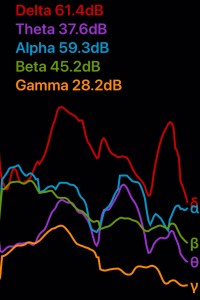
Using the MindMonitor app and a Muse S Athena, I monitor my own neural response to 40 Hz pulsed NIR light (and sometimes 40 Hz isochronic tones). The Muse S Athena is a fascinating device for neurofeedback training, meditation, and sleep monitoring.
| Brainwave | Brain function | Hz Range | Modulation Benefits |
|---|---|---|---|
| Delta | The main EEG wave of deep sleep. Suppression during sleep leads to inability of bodily repair. | 1–4 Hz | Sleep induction, deep relaxation, possible pain reduction |
| Theta | The appearance of the theta wave is one of the signs of drowsiness. | 4–8 Hz | Memory enhancement, creativity, meditation, stress reduction, pain reduction |
| Alpha | Dominant brainwave in relaxed, awake adults who their eyes closed; it decreases with eyes open or mentally active condition | 8–12 Hz | Relaxation, stress reduction, improved mood, perceptual learning, pain reduction |
| Beta | Increases in a state of alertness or anxiety. Associated with an active, busy brain. | 13–30 Hz | Alertness, concentration, cognitive performance |
| Gamma | Associated with high-level cognitive functions including learning, memory, and information processing | 30–100 Hz | Higher cognitive processing, attention, benefits in neurodegenerative disorders, mood, memory, and cognition |
The fastest brainwave frequency is called the gamma frequency. Gamma brainwaves are usually linked to important brain functions like attention, memory, and learning. These waves represent the brain’s “high-performance mode,” facilitating rapid information processing and the integration of different cognitive functions.
Scientists have found that people with memory problems, such as those with Alzheimer’s disease, often have less gamma activity in their brains. In animal studies, when researchers used techniques to increase gamma brainwaves, they saw improvements in memory and learning. They also noticed that this could help protect brain cells and reduce some of the changes seen in diseases like Alzheimer’s.

Gamma brainwave entrainment with flashing lights or sounds at a certain speed (about 30–100 times per second, aka Hertz or Hz) has shown particular promise. There is evidence that 40 Hz optogenetic (visual) stimulation protects brain neuroplasticity after stroke. This can help the brain “sync up” to the gamma frequency. Some studies suggest that this might not only help with memory and attention, but could also have positive effects on brain health by influencing brain cells and even reducing harmful proteins like amyloid beta, a hallmark of Alzheimer’s Disease.
So how else is this be applied? Interestingly enough, you don’t even have to flicker a light into your eyes to alter your brainwaves. Using near infrared light photobiomodulation, a study pulsed near infrared light on the palm of the left hands of its participants:
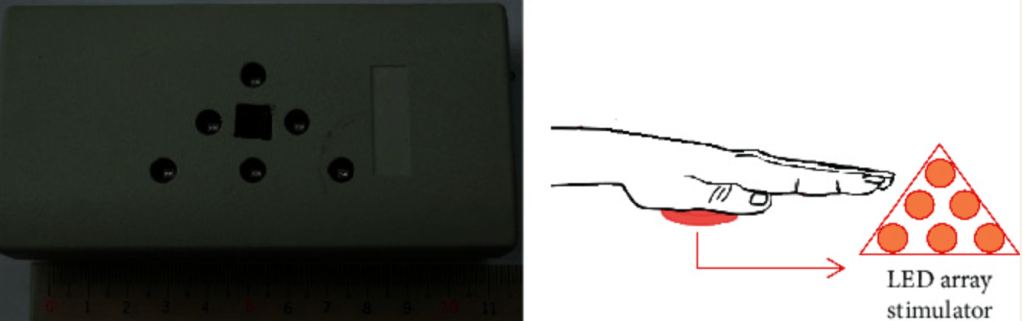
Effect of Near-Infrared Pulsed Light on the Human Brain Using Electroencephalography
This study investigated the effects of near-infrared (NIR) pulsed LED light (850 nm, 10 Hz, 32 J/cm², 10 minutes) applied to the palm and measured brainwaves by EEG. The main findings were:
- Alpha brainwave activity (8–12 Hz) significantly increased in the occipital, parietal, and temporal regions during and after LED stimulation. This increase persisted for at least 15 minutes after the stimulation ended.
- Theta activity (4–7 Hz) also increased, particularly in the posterior head region, with a notable effect in the right temporal area.
- Beta activity (13–50 Hz) increased in the right parietal area with higher LED dosage.
The brain works in a contralateral way, so stimulation of the left side of the body should be expected to influence the right hemisphere of the brain.
What if you don’t have a NIR/red light panel with pulsed light? You can get started with headphones or a bluetooth speaker!

Binaural beats are special sounds created by playing two tones with slightly different frequencies in each ear. Your brain will hear/create a third rhythmic “beat” that is the difference between the two tones. For example, if a 20 Hz tone is played in the left ear and a 60 Hz tone in the right ear, the brain detects a binaural beat at the gamma frequency of 40 Hz (60 Hz – 20 Hz). This perceived beat is not an actual sound, but a result of the brain processing the frequency difference between the two tones. Binaural beats require stereo headphones/earbuds to work because a different frequency must be played in each ear.
Getting started with Binaural Beats
1- Choose the Right Equipment: Use stereo headphones or earbuds. Binaural beats only work if each ear hears a separate tone.
2- Find a Reliable Track: Look for audio tracks labeled with the desired effect (relaxation, focus, or sleep) and the frequency range. Remember the basics of the frequencies:
• Delta (0.5–4 Hz): Deep sleep
• Theta (4–8 Hz): Relaxation and reduce anxiety.
• Alpha (8–13 Hz): Light awake relaxation and stress reduction
• Beta (13–30 Hz): Alertness and cognitive performance
• Gamma (>30 Hz): Attention, memory, complex processing
3- Set Aside Time: For best results, listen for at least 15–30 minutes. Longer sessions may be more effective, especially for relaxation and sleep.
4- Create a Comfortable Environment: Sit or lie down in a quiet place. Close your eyes and relax.
5- Use Before or During Tasks: For relaxation or sleep, listen before bedtime or naps. For focus, listen before or during study or work sessions.
6- Volume: Keep the volume at a comfortable level. It should not be too loud or distracting.
What to Expect
Some people feel more relaxed, focused, or sleepy after listening to binaural beats. Effects may take a few sessions to notice. Try using binaural beats daily for a few weeks. Not everyone experiences the same benefits. If you do not notice changes, it may not work for you.
Safety and Tips
• Binaural beats are generally safe for healthy adults.
• This can be sort of hypnotic—do not do this while driving or doing tasks that require full attention.
• If you feel uncomfortable or anxious while listening, stop and try a different frequency or shorter session.
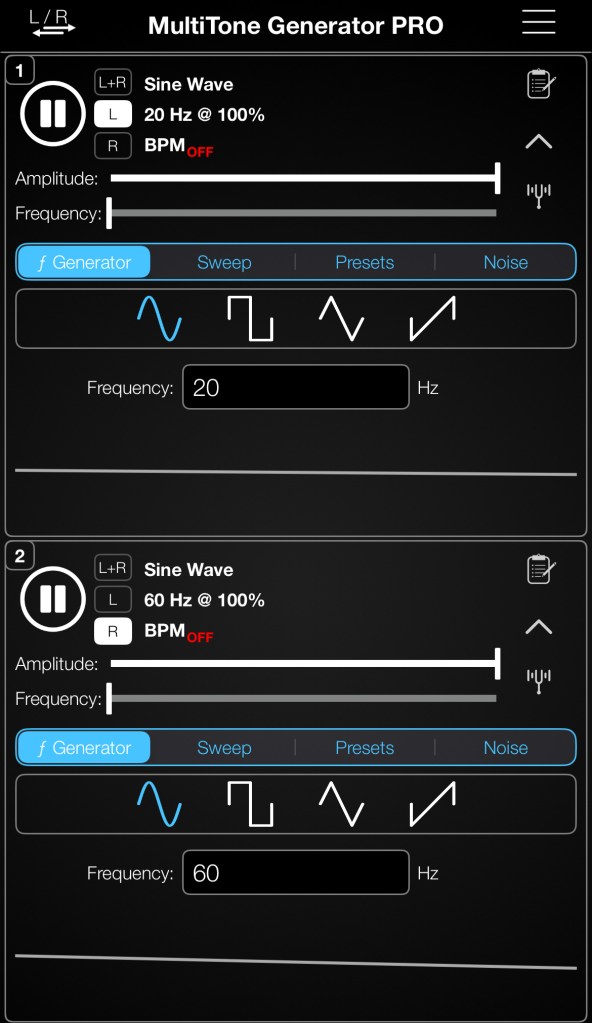
You can make your own binaural beats or isochronic tones on your phone. Isochronic tones can be played over speakers and may even be more effective for BWE than binaural beats. This app is $10 for the full version, which allows a wide range of frequencies and the creation of binaural soundscapes.
Isochronic tones are single tones that pulse on and off at regular, evenly spaced intervals. In brainwave entrainment, these tones are used to synchronize brain activity to a desired frequency by delivering clear, repetitive auditory pulses. For example, an isochronic tone set at 10 Hz will produce 10 distinct pulses per second, which the brain can follow, promoting brainwave activity at the alpha frequency.
Isochronic tones have some advantages over binaural beats. Binaural beats require stereo headphones for the effect and may be less pronounced, especially in individuals with hearing differences between ears. An isochronic tone can be played over a speaker, and isochronic tones might also be more effective than BB.
A 2024 study directly compared isochronic tone stimulation to gamma-frequency binaural beats (BB) and white noise, finding that isochronic tones produced significantly greater changes in EEG gamma power and a progressive increase in normalized EEG power compared to BB. Isochronic tones also elicited distinct modulation in the alpha band, with a progressive decrease in power, a pattern not observed with BB or white noise. These findings indicate that isochronic tones can induce more robust and selective modulation of neural oscillations than BB, so for cognitive enhancement and clinical applications, perhaps we should be looking to isochronic tones first!
 Evidence-based care for whole-person health.